
Snow Hauling and Removal in Saskatoon
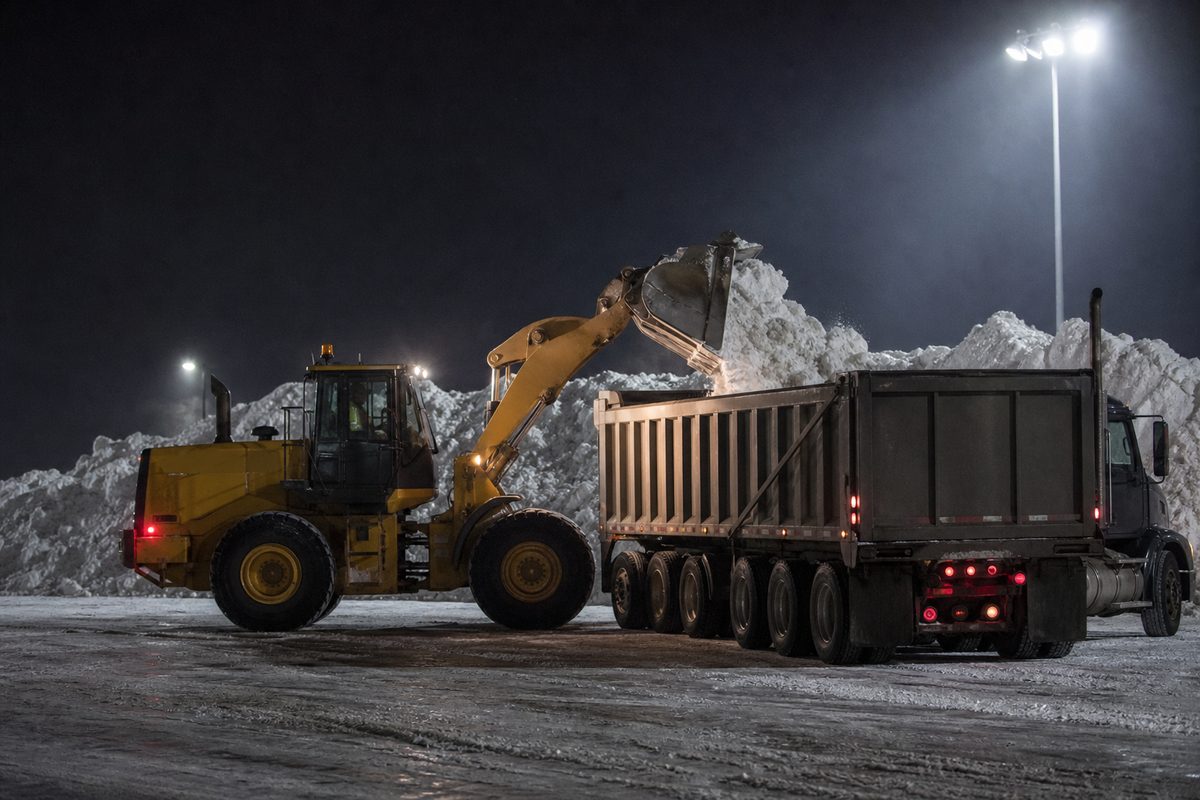
When the piles have taken every metre they can, we load them out instead of rearranging them.
Every property has a snow storage limit, and most of them find it in the same month. What was a tidy bank in December is now taking parking stalls, blocking the view at the exit, and sitting on the catch basin that is supposed to handle the melt.
Saskatoon Snow Co loads it out and trucks it away.
The Point Where Pushing Stops Working
Snow does not leave Saskatoon between storms. It accumulates from November through March, and every clearing pass adds to piles that are already compacting under their own weight.
The limit shows up as a choice. Push it here and lose stalls. Push it there and block the sightline at the approach. Push it back and it narrows the driveway. Once every direction costs something, more plowing just concentrates the problem.
What Gets Recovered
Parking is the obvious one. On a lot with thirty stalls, banks slumping outward through repeated thaw and freeze can take four or five of them in the busiest part of the year.
Sightlines are the safety one. A bank at the exit that started knee-high in December grows every storm until drivers are pulling onto the street blind.
Drainage is the one that gets overlooked and costs the most. A pile sitting on a catch basin has nowhere to go when it melts, so the water spreads across the lot and refreezes overnight into the largest ice sheet on the property.
Timing It Before the Melt
Hauling in late winter looks like paying to remove snow that is about to disappear on its own. The melt is exactly the reason to do it.
A season of accumulated, compacted snow holds far more water than its size suggests, and it releases that water over a short warm stretch. If those piles are sitting near a parkade ramp, a low corner, or a foundation, that is where the water goes. Taking the volume off the property beforehand is a drainage decision.
How It Runs
Banks get loaded and trucked to an approved disposal site. On commercial properties the work is usually scheduled overnight to keep the lot usable during business hours.
Residential hauling is less common but real, mostly on narrow older lots with short driveways and nowhere to put a winter’s worth of snow. Nutana and Riversdale properties with lane access run into this more than newer neighbourhoods with wider yards.
For the clearing work that comes first, see snow plowing and parking lot snow removal.
What's Included
- Banks loaded and trucked off the property
- Parking, sightlines, and drainage recovered
- Scheduled before the spring melt, not after
- Tight urban lots and narrow residential yards
- Booked as needed or written into a seasonal plan
Other Services We Offer in Saskatoon
Snow Hauling & Removal Questions
When is hauling actually necessary?
When there is nowhere left to push without giving something up. On a small commercial lot that means losing stalls or blocking the exit sightline. On a narrow residential lot it means banks closing in on the driveway width. Once you are choosing which problem to accept, the piles need to leave.
Why haul in February instead of waiting for spring?
Because the melt is the problem. A winter's worth of piled snow releases a large volume of water in a short window, and if it is sitting somewhere with poor drainage it goes into a low spot, a parkade ramp, or a foundation. Removing the volume beforehand is a drainage decision as much as a parking one.
How much snow are we talking about?
More than it looks. Piled snow compacts heavily under its own weight through the season, so a bank that reads as a modest ridge in March holds several times the volume of the fresh snowfall that started it.
Can hauling be part of a seasonal contract?
Yes, and on tight lots it should be, because the need is predictable. Writing an allowance into the agreement is cheaper than an emergency call in the middle of a bad February.
Get a Free Snow Hauling & Removal Quote
Seasonal routes fill before the first real storm. Get a free quote on your property now.