
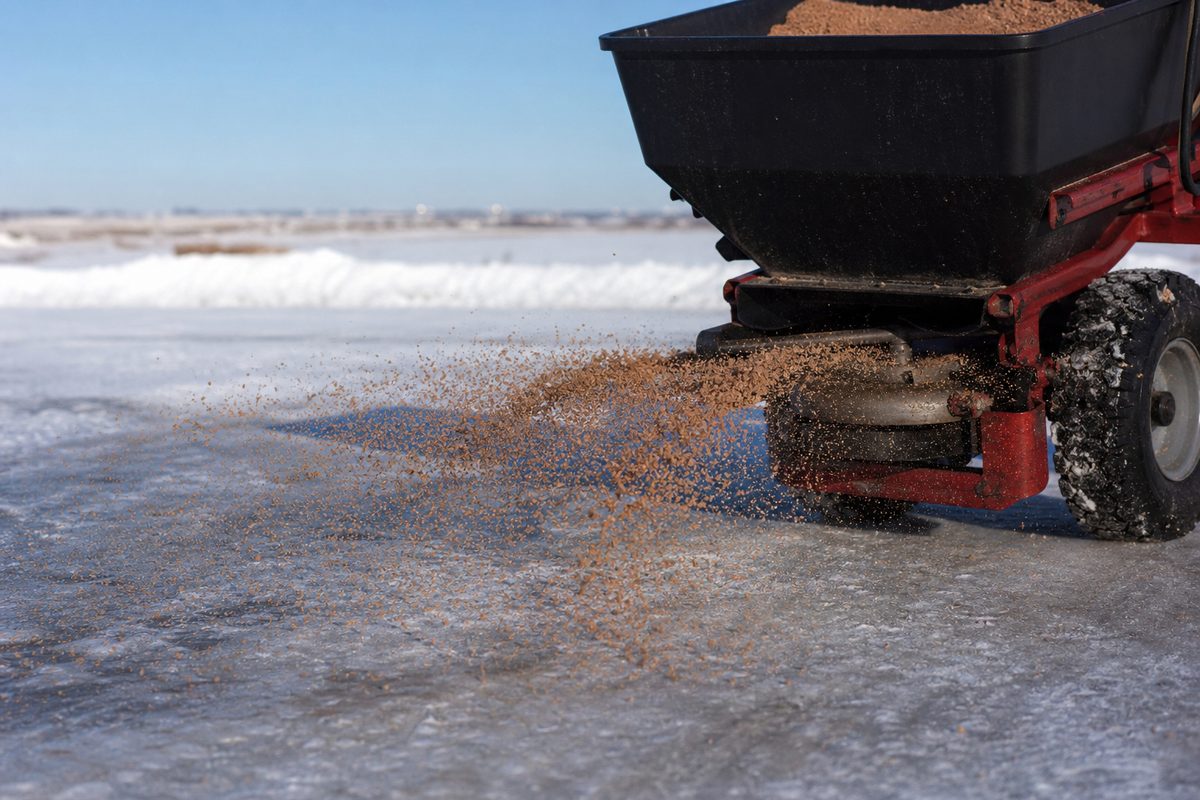
Sanding Services in Saskatoon
Traction for the deep-cold weeks when salt has stopped working, and for surfaces salt would damage.
There is a stretch of every Saskatoon winter, usually somewhere in January, where salt is a waste of money. It sits on the ice looking like it is doing something, and the temperature is far below where it can.
That is when sand earns its place. Saskatoon Snow Co carries it through the season for exactly those weeks.
Mechanical, Not Chemical
Salt works chemically. It dissolves into a film of surface water and lowers the freezing point, which requires water and a temperature where the reaction actually proceeds. Get cold enough and it slows to nothing.
Sand does not participate in any of that. It sits on the ice, provides a rough surface with grip, and works identically at minus five and at minus thirty. The ice is still there. You just stop sliding on it.
That distinction matters here because Saskatoon spends real stretches of the winter below salt’s useful range. A week where daytime highs sit in the high minus twenties is unremarkable, and during it sand is the only thing on the truck that will actually help.
Surfaces That Should Not See Salt
Concrete poured within the last few years is the main one. Salt damages it indirectly, by driving repeated melt and refreeze at the surface, which pushes water into the pores where it expands and lifts the finish. Exposed aggregate and decorative finishes are more vulnerable again because there is more surface area exposed.
Interlock and pavers have the same issue in the joints, and salt-laden meltwater running off a driveway onto a lawn or a bed does the plantings beside it no favours.
On those surfaces sand is the default from us rather than the exception, whatever the temperature.
Where It Goes First
Walkways, steps, and entries come before open pavement. Grip matters most where people are moving slowly, turning, or carrying something, and those are the surfaces where a fall actually happens.
Sanding is most effective on a cleared surface or on bare ice. Spread on top of loose snow it disappears under the next centimetre and gets pushed off with it, so it follows clearing rather than substituting for it.
Spring
Sand does not disappear with the ice. It ends up across driveways, walkways, and lot edges once things melt, and it will find catch basins if it is left.
A spring sweep is available at the end of the season on properties that want it, which is most commercial sites and a fair share of residential ones.
For the chemical side and when it is the better choice, see ice control and salting.
What's Included
- Works at temperatures where salt does nothing
- Safe on new concrete, pavers, and exposed aggregate
- Walkways and entries prioritised
- Immediate traction, no waiting for a reaction
- Spring sweep-up available
Other Services We Offer in Saskatoon
Sanding Services Questions
Does sand melt ice?
No, and that is the point. Sand sits on the surface and gives boots and tires something to grip. The ice stays where it is. In a Saskatoon January that is a feature, because nothing chemical is melting much at minus twenty-eight anyway.
Is sand better than salt for new concrete?
For a driveway poured in the last few years, yes. Salt damages concrete by driving extra melt-freeze cycles at the surface, which works water into the pores where it expands. Sand does not create that cycle, so it does not contribute to spalling.
What happens to all the sand in spring?
It ends up on the surface and along the edges once the ice goes. A spring sweep clears it off driveways and walkways, and it is worth doing rather than leaving it to wash into catch basins.
Can you sand without clearing the snow first?
On an ice layer with nothing on top, yes, and that is often the call after a melt-freeze cycle. Sanding on top of loose snow is wasted, because it disappears under the next centimetre and gets pushed off with it.
Get a Free Sanding Services Quote
Seasonal routes fill before the first real storm. Get a free quote on your property now.